
Context Engineering for AI Agents
Executive Summary
- Definition & Importance: Context engineering is the systematic design of the information passed to an AI agent (an LLM-driven system) at each step. It goes beyond prompt engineering by managing the entire context (system instructions, tool interfaces, memory, etc.) rather than just crafting one-off prompts. This discipline is essential for building reliable, production-ready AI agents. As one industry survey notes, only ~17% of organizations have deployed AI agents so far, but over 60% plan to do so by 2028, underscoring the urgent need for robust context management.
- Core Concepts: Good context engineering means curating the smallest set of high-value tokens that ensure correct, consistent agent behavior. Key quality criteria include relevance, sufficiency, isolation, economy, and provenance of information. In practice, context engineers use memory systems, retrieval (e.g. vector databases), token filtering, and summarization to feed LLMs only the most pertinent facts at the right time.
- Strategies and Components: Effective context engineering for agents involves four main strategies (as outlined by industry leaders): Write, Select, Compress, and Isolate. For example, “writing” context means storing useful information (like web-sourced facts or interim reasoning) in external memory or files for later reuse. “Selecting” involves semantic search over knowledge stores (vector databases) to fetch exactly what the agent needs. “Compressing” uses summarization or abstractions to condense long inputs, and “isolating” means splitting tasks or agents so each has a focused, compact context (preventing context bloat).
- Challenges & Solutions: LLMs have finite context windows, so feeding them too much information leads to “context rot” – a degradation in accuracy as irrelevant tokens accumulate. Context engineering treats the context window like RAM: it must be carefully managed. Techniques like relevance filtering (ranking and pruning data) and grounding (forcing the model to use a factual knowledge base) greatly reduce hallucinations and waste. Modular multi-agent designs (e.g. dedicated search agents or calculators) also prevent any single agent’s context from overflowing.
- Business Impact: Well-designed context engineering directly controls costs and accuracy. By sending fewer, more relevant tokens, it cuts cloud/compute expenses and latency. It also makes outputs traceable and compliant (important in finance/healthcare) by tying every answer to vetted data sources. In practice, companies should treat context management as a core strategy: building a “context layer” from the start avoids excessive retraining and expensive fixes later.
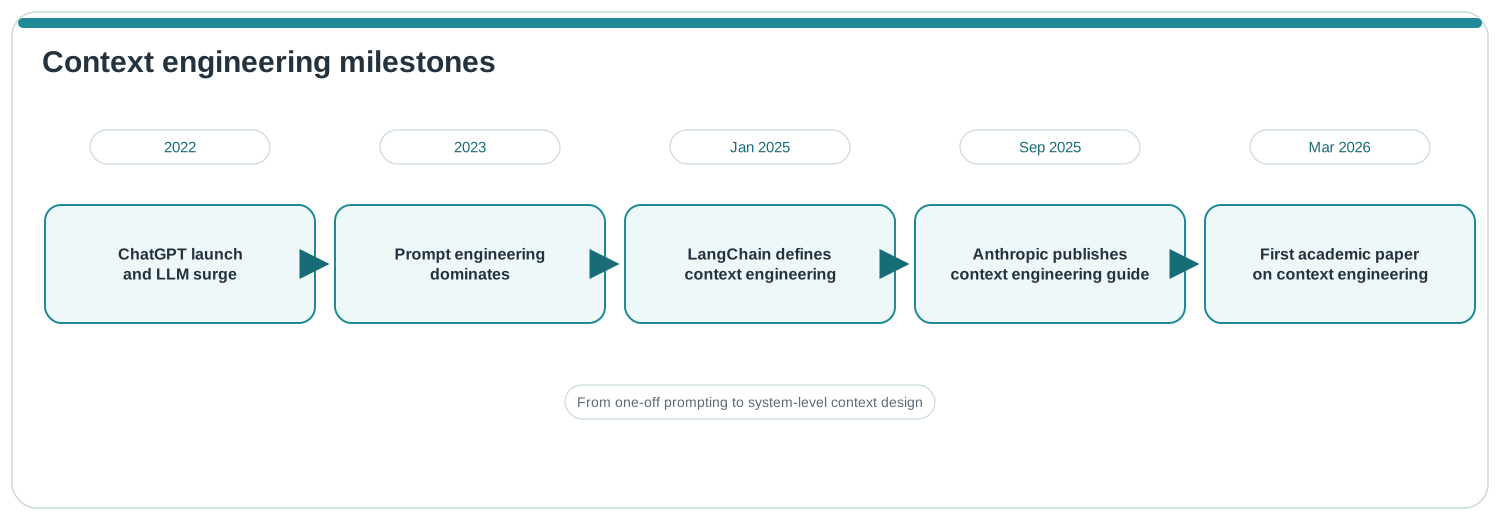
- Key Developments: The idea of context engineering has recently emerged. As shown below, it was formally named in 2025–2026 by industry leaders and researchers. The timeline highlights milestones from the ChatGPT era to today.
Context Engineering vs. Prompt Engineering
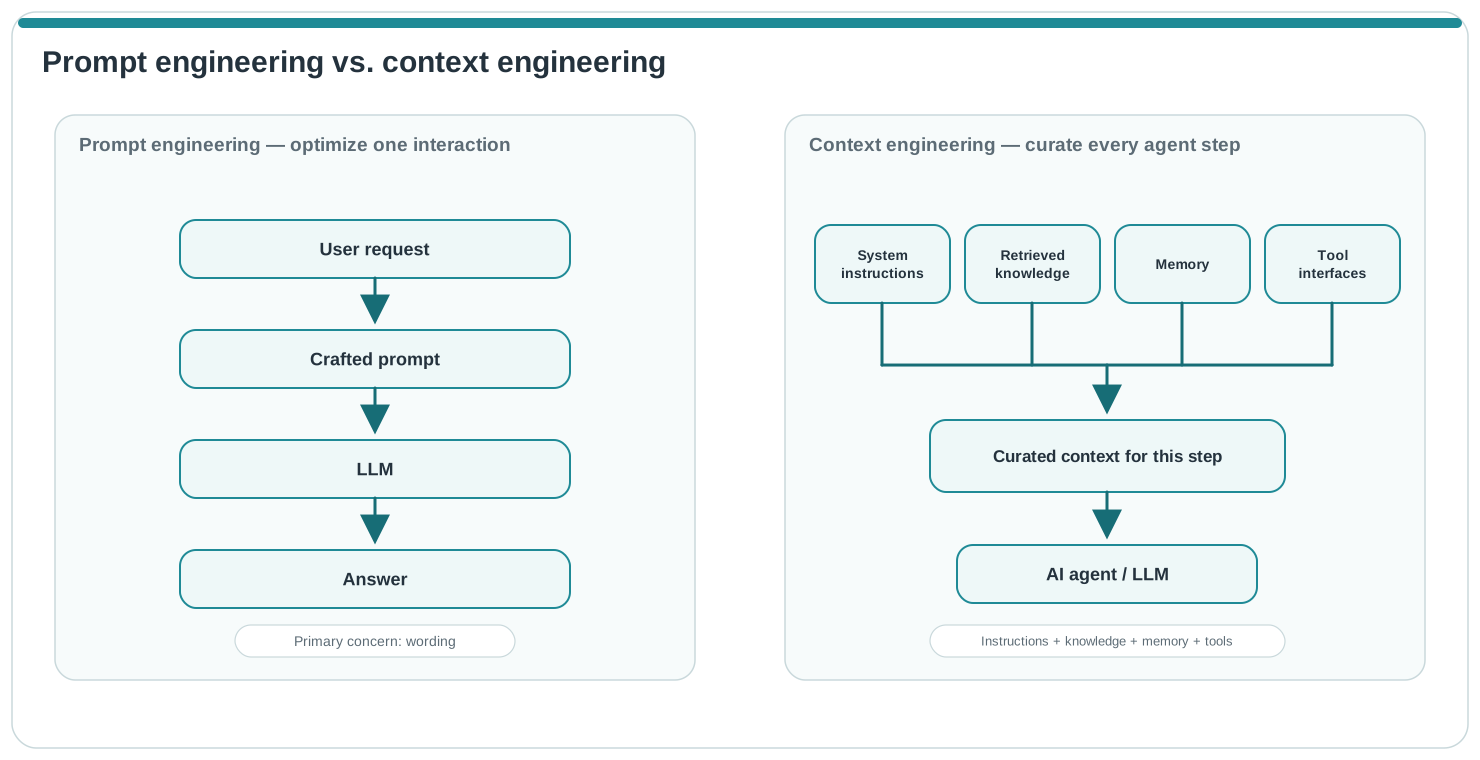
Unlike traditional prompt engineering (crafting a single static prompt), context engineering is an iterative, system-level process of deciding what information (instructions, knowledge, tool specifications, memory) goes into the model’s input at each step. Anthropic sums it up: prompt engineering is about writing effective instructions for one task, but as agents carry out many steps, engineers must curate the whole context window to steer behavior. In short, prompt engineering optimizes one query, whereas context engineering manages the flow of data over an entire agentic workflow.
Context engineering treats the LLM’s context window like limited RAM: every new token consumes part of the model’s attention budget. Studies have shown that as more tokens crowd the window, models can “forget” earlier information (called context rot). Thus, context is a finite resource. Engineers must balance providing enough information (to avoid missing critical details) while not overwhelming the model. A guiding principle is: include the minimal complete context needed for the agent’s goal.
Core Principles and Components
At a technical level, context engineering involves building the data and tool pipeline around the LLM. The main components are:
- Data Retrieval and Memory: Use vector databases and embeddings to retrieve relevant documents or prior notes. By indexing an organization’s knowledge (PDFs, databases, etc.) into a semantic vector store, an agent can search and inject pertinent facts on demand.
- Token Management (Relevance Filtering): Automatically rank and trim the retrieved information. For example, algorithms can score each document by relevance to the current task and only pass top-ranked facts to the model, discarding duplicates and irrelevant details. This ensures the final prompt is concise and high-utility, cutting cloud costs and speeding up inference.
- Real-Time Orchestration: Connect to live data sources (APIs, databases) so context is always current. Agents often need up-to-date facts (inventory levels, financial data, etc.), not stale offline information. A robust context layer hooks into enterprise systems securely, refreshing context at runtime. For example, an e-commerce agent would check real-time stock levels via API instead of relying on an outdated database.
- Modular Tools and Agents: Instead of one monolithic agent, split tasks among specialized sub-agents to isolate contexts. In practice, a “planner” agent might handle high-level strategy, while a separate “search” agent handles web queries. This prevents any single agent’s context from growing unbounded. The example below illustrates this approach.
Case Study: Multi-Agent Architecture for Research
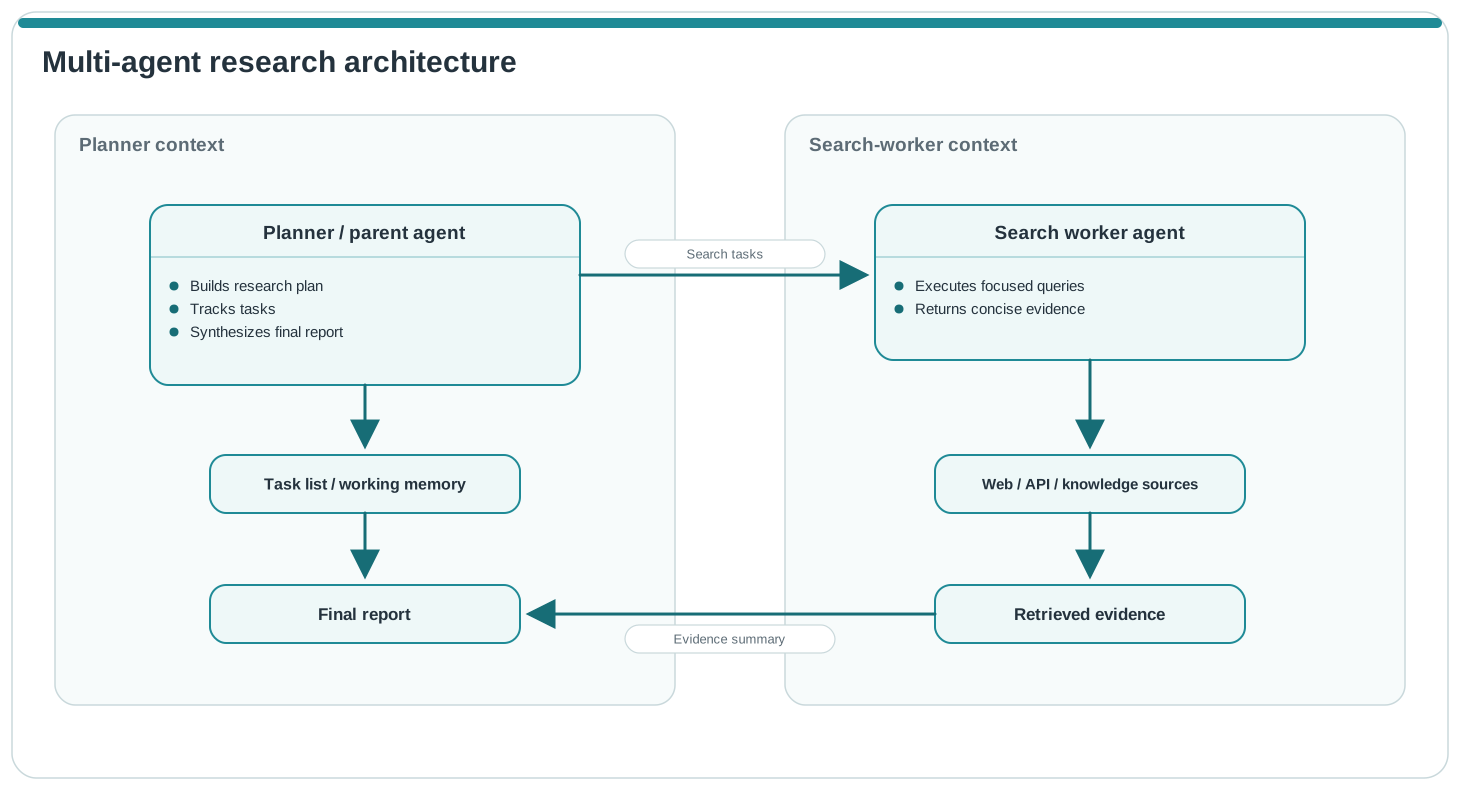
In one design, the parent agent orchestrates the research plan, while a dedicated search-worker agent handles web queries. This separation of concerns improves reliability and efficiency:
- Clear Responsibilities: The planner agent manages the workflow (task list, report generation) while the search agent focuses solely on executing searches and returning results.
- Improved Reliability: With each agent focused, the system is less likely to drop steps (e.g. forgetting a search query). Each agent’s prompt context stays shorter and more targeted.
- Model Specialization: Different agents can use different LLM models tailored to their tasks. For instance, the planner might use a more capable (but slower) model for reasoning, while the search agent uses a faster model for fact-finding. This reduces token waste and cost while maintaining performance.
In this example (from a published agent tutorial), adding a search agent overcame previous failures (context bloat, missed tasks) and yielded a 3-step search plan and final report as intended. The design principle is clear: split complex workflows into multiple agents to keep each context small and meaningful.
Strategies and Best Practices
Building on these components, practitioners commonly group context engineering techniques into four strategies:
- Write (Memory): Persist important information outside the context window. Agents can “take notes” in a memory store or scratchpad. For example, after planning steps, the agent may write its plan to memory so it can refer back if the chat history grows too large. Memories can also accumulate across sessions (e.g. saving user preferences). This way, the agent can recall prior decisions without re-injecting all past prompts.
- Select (Retrieval): Use semantic search to fetch context. Whenever a new query arrives, the agent queries its knowledge base for relevant data and includes only the top results in the prompt. This ensures the model sees factually correct information (which it might not “know” otherwise) while ignoring irrelevant documents.
- Compress (Summarization): Summarize or chunk long content. If the agent has accumulated a lot of text (e.g. thousands of tokens of conversation or document excerpts), it can run a summarization pass to compress that into a few key points. The agent can then feed the summary (rather than raw text) into the next prompt, preserving essential meaning with far fewer tokens.
- Isolate (Context Separation): Keep contexts separate per subtask or agent. For example, maintain distinct chat threads or state objects for different steps. By isolating, you avoid “context clash” where irrelevant chat history confuses the agent. This often goes hand-in-hand with multi-agent designs (as above): each specialized agent has its own focused context.
A compact table of these strategies is shown below. Each strategy helps manage the context window to balance completeness with brevity:
| Strategy | Description |
|---|---|
| Write | Store outputs or key info externally (e.g. memory database, file) so it can be re-fed when needed. |
| Select | Dynamically retrieve only relevant documents or memories via semantic search (vector DBs). |
| Compress | Summarize or distill long text into shorter form, reducing token count while preserving meaning. |
| Isolate | Split tasks/contexts (or agents) so each context is small and scoped to a specific function. |
Overcoming LLM Limitations
LLMs by design have limited “working memory.” As context windows grow, models exhibit drift (context rot) and inefficiency. Good context engineering directly addresses these limits:
- Grounding to Facts: One core practice is grounding the model by forcing it to use a vetted knowledge base for answers. By including only authoritative documents in the context, hallucinations drop dramatically. In other words, context engineering sets a factual “frame” around the model. Combined with observability tools, teams can trace exactly which source the agent used for each answer.
- Attention Budget Awareness: Since each token in context competes for the model’s attention, engineers minimize consumption. Anthropic recommends “the smallest possible set of high-signal tokens” for any task. This often means iteratively pruning the prompt content and encoding only what’s necessary.
- Privacy and Security: In enterprise settings, context engineering also enforces data governance. Sensitive data should be masked or redacted before entering the context. For example, pipelines may anonymize personal info or filter proprietary financial figures, ensuring compliance. Role-based controls can further ensure an agent only retrieves data it’s allowed to see, preventing leaks of confidential context.
- Cost Control: Every token costs money. By filtering out redundant text and reducing the input size, context engineering cuts the total cost of ownership. For instance, selective data delivery (only the most relevant documents) lowers per-query costs without hurting output quality. Moreover, a lean context window means faster responses and more scalable systems overall.
Context Engineering in Practice
Context engineering is still a maturing discipline. In mid-2025, companies like LangChain began formalizing it and providing framework support. Anthropic’s 2025 blog further popularized the concept, urging engineers to treat context as their top priority. Academic research has now codified these ideas: one recent paper defines context engineering as a standalone layer in the agent stack. It proposes a four-level pyramid model (prompt, context, intent, specification engineering) for enterprise agents, highlighting that context is the foundation.
In deployment, best practices include continual iteration: context engineering is not a one-off task. Every agent loop (each new question-answer) presents a chance to update or refine the context for the next turn. Teams often build tools to automate parts of this loop (e.g. automatic relevance scoring, memory updates, or context re-formatting) to handle the complexity.
Conclusion
As AI systems shift from isolated chatbots to complex autonomous agents, context engineering becomes indispensable. It is the craft of supplying an AI with precisely the information it needs, no more and no less, enabling reliability and efficiency at scale. By thinking of context as the agent’s working memory or operating system, engineers can systematically improve performance and trustworthiness. This report has outlined the key concepts, strategies, and benefits of context engineering. Organizations adopting AI agents should invest in strong context frameworks – indexing their data, architecting modular agents, and setting up continuous context pipelines – to make these systems practical and safe for real-world use.
For production threat modeling and operational controls around those context and tool boundaries, see AI Agent Security in Production.
Design a production-ready context layer for your AI agents
Retesys can integrate LLMs and AI agents with enterprise knowledge, retrieval, memory, APIs, orchestration, observability, and secure business workflows while keeping context focused, traceable, and cost-efficient.
Discuss Your AI Integration Project