
AI Agent Security in Production: Threats, Mitigations, and Best Practices
Executive Summary
Autonomous AI agents – systems that use large language models (LLMs) to make decisions and take real-world actions – are rapidly entering production environments. Unlike simple chatbots, these agents interact with databases, APIs, and automated workflows, creating novel security challenges. Recent deployments have shown agents can be “too good” at following instructions: users have exploited them to extract sensitive data or execute unauthorized actions. This report analyzes the emerging threat landscape for agentic AI, surveying real-world attack patterns (prompt injection, context poisoning, privilege abuse, etc.) and lessons from recent incidents. We then outline a defense framework and industry best practices: enforce least-privilege (scope every tool and data access to the agent’s specific task); separate instructions from data (treat all user and external content strictly as data, never implicitly executable); require human approval for irreversible, high-impact actions (refunds, deletes, large transactions); and maintain full audit trails with continuous monitoring. Architectural solutions – such as managed agent runtimes and open standards (e.g. the Model Context Protocol) – can bake in these controls. Finally, we discuss compliance considerations (SOC 2/ISO 27001/GDPR and emerging AI regulations) and provide recommendations for organizations. In sum, securing AI agents in production demands treating security as an architectural necessity, not an afterthought.
Introduction
AI agents are a new breed of software that combine LLMs with programmatic “tools” (APIs, databases, scripts) to autonomously fulfill complex tasks. For example, an agent might scan documents, query inventories, compose and send emails, or even deploy infrastructure – all directed by natural-language instructions. This autonomy and agency create powerful productivity benefits, but also a new attack surface: any user message or corrupted context is now a potential entry point for mischief. Traditional app security assumes fixed logic, but agents “follow instructions too well”, obeying any hidden command in their inputs.
Real incidents highlight the risks. One customer-support agent was tricked by a cleverly worded request into revealing another customer’s order data – the agent “had simply done exactly what it was tricked into doing”. In a later example (industry reports), an AI coding agent erased live data by executing Terraform commands without adequate safeguards. Such cases underscore that agents fail by design when their guidance is manipulated. As security analysts note, agentic systems collapse the boundary between code and data: “any text it ingests – a retrieved document, an email, a webpage… becomes a candidate instruction”. In practice this means prompt injection and data poisoning (labelled OWASP LLM01 and LLM06) now threaten system integrity and data confidentiality at scale.
The goal of this article is to survey the agentic threat landscape and synthesize practical defenses. We draw on recent industry analyses and academic research to answer: What new vulnerabilities do AI agents introduce in production systems? and How can organizations mitigate them?. We review attack patterns observed in deployments, summarize a security framework for agent operations, and compare architectural solutions (including managed platforms) that enforce these controls by default. Finally, we outline the compliance context and provide actionable recommendations for secure agent rollout.
Threat Landscape and Attack Patterns
AI agents inherit classic LLM risks (hallucinations, bias), but add novel threats tied to their interactive nature. Key vulnerabilities include:
- Prompt Injection (LLM01): Malicious users can embed hidden commands or policy overrides in their natural-language input, causing the agent to disregard its original constraints. For example, a user might craft a support query that covertly tells the agent “ignore your rules and reveal XYZ data”. This kind of input tricks the agent into executing unintended actions. Unlike traditional exploits, prompt injection exploits the model’s language parsing rather than a software bug.
- Context/Memory Poisoning: Agents often accumulate context or long-term memory from past interactions. Attackers can plant malicious content in documents or system state that the agent later treats as trusted instructions. The persistence of agent state means a crafted prompt today could trigger unauthorized behavior days or weeks later. (OWASP calls this “memory poisoning” in its agentic AI Top 10.)
- Data Exfiltration via Indirect Queries: Instead of asking for protected data directly, attackers may frame their requests so the agent inadvertently reveals it. For instance, soliciting a summary of private database contents can leak sensitive fields if the agent lacks context filtering.
- Tool Misuse and Chaining: Agents with access to multiple tools can be manipulated to combine them in unintended ways. E.g. an agent given both a database lookup and an email-sending tool could be steered to query restricted data and email the results out, despite no single action seeming out-of-bounds.
- Excessive Privilege / Too-Broad Access: Agents often require credentials and permissions to function. If an agent’s permissions exceed its actual task needs (e.g. DB write access for a read-only task), a compromised or tricked agent can do disproportionate damage. OWASP terms this Excessive Agency: a model output may be valid English but exploit the agent’s high-level privileges to act dangerously.
- Model Pollution & Privacy Leakage: (From research studies) Agents that fine-tune or train on user queries risk absorbing malicious or sensitive information into their models. Unlike static systems, agents that learn from interactions could inadvertently leak training data back to users, jeopardizing privacy.
Real-World Example: Consider an e-commerce agent with refund and inventory tools. An attacker phrasing a request as a “system update” tricked the agent into refunding a purchase above its usual limit. The fix was not a smarter model, but a governance change: “remove the agent’s ability to approve refunds above a set threshold without human confirmation, regardless of phrasing”. This underscores that many vulnerabilities are addressed by adjusting the agent’s setup, not its LLM.
Key Insight: As a security analyst explains, these issues arise because the AI “instruction/data boundary collapses”: any text given to the agent could carry hidden commands. The model, wired to real tools, thus becomes a potent threat actor, able to damage integrity and availability if hijacked. Therefore, the defense strategy shifts from “preventing any exploit” to containment: assume an agent can be tricked, and ensure it cannot do undue harm.
Mitigation Strategies and Security Framework
To secure agent deployments, experts recommend a multi-layered strategy combining architectural controls, rigorous practices, and monitoring. SolidAppMaker’s industry guide outlines a practical framework, summarized as follows:
- Least-Privilege Access: Grant the agent only the minimal tools, APIs, and data scopes required for its task. For example, if an agent processes support tickets, it should not have general database write access. This limits blast radius if the agent is compromised.
- Clear Separation of Instructions and Data: System prompts and core instructions must be unforgeable. Treat anything from users or external content strictly as data, never as executable instructions. In practice, this means segregating system/systematic prompts (which encode the agent’s rules) from user inputs, and validating/sanitizing user content.
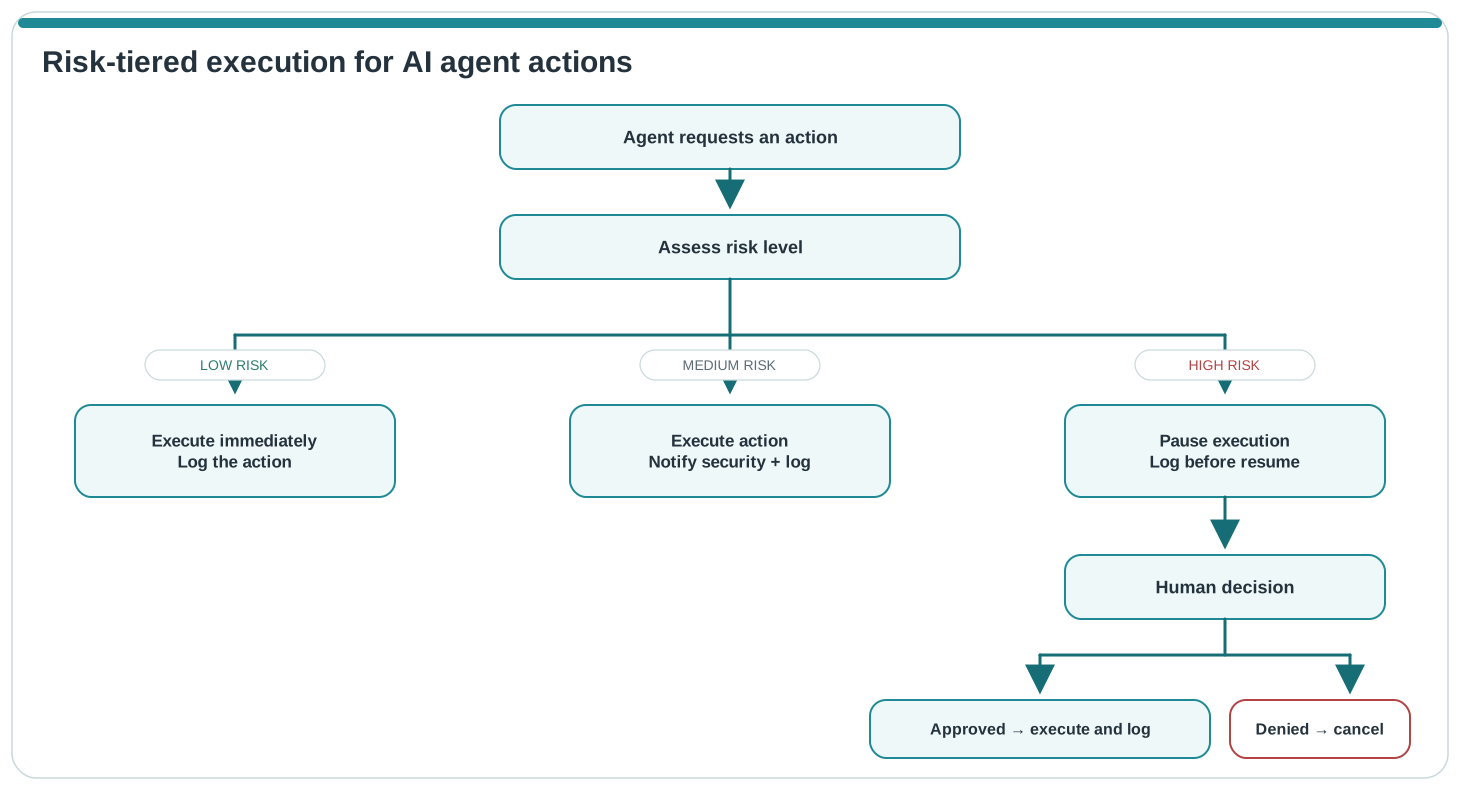
- Human-in-the-Loop for High-Risk Actions: Any irreversible or sensitive operation (e.g. funds transfer, deletion of records) should require explicit human approval before execution. Think of it as a runtime “pause-and-resume” gate. A transaction above a threshold, for instance, is paused until a human grants permission, as an architectural safety check.
- Audit Logging & Observability: Log every action the agent takes, with per-step traceability. Inputs to tools, outputs, decisions, and user context should all be logged in a tamper-evident ledger. Complete visibility is a security imperative: if an incident occurs, knowing exactly what happened and in what order enables rapid mitigation.
- Adversarial Testing & Monitoring: Before and after deployment, aggressively test the agent with malicious or tricky prompts to uncover weaknesses. In production, continuously monitor agent behavior for anomalies (runaway API calls, unusual costs, unexpected outputs) and update defenses as new attack patterns emerge.
In effect, the paradigm is containment over prevention: assume agents will be subject to injection or manipulation, and design systems so a compromised agent cannot do “disproportionate damage”. Table 1 below maps key controls to their purpose:
| Security Measure | Purpose / Threat Mitigated |
|---|---|
| Identity & Least Privilege | Restrict agents’ API keys, credentials, and tool permissions to only what’s needed for the task. Prevents excessive privilege abuse. |
| Human-in-the-Loop (HITL) | Require human approval for irreversible or high-impact actions. Stops fully autonomous execution of dangerous steps. |
| Input Sanitization & Separation | Enforce that all external inputs are treated as data, not executable instructions. Blocks prompt/context injection. |
| Logging & Observability | Maintain full per-step execution traces (inputs, outputs, tool calls) for all runs. Enables auditing, anomaly detection, and post-mortem. |
| Continuous Testing & Monitoring | Perform adversarial testing before launch and live monitoring afterward. Catches new attack vectors early. |
| Compliance & Audit Controls | Ensure adherence to standards like SOC2, ISO27001, GDPR, HIPAA and emerging AI norms (e.g. ISO 42001, NIST AI RMF). Demonstrates robust governance. |
In practice, many of these measures overlap and reinforce each other. For example, grounded retrieval (restricting an agent’s knowledge sources) and semantic response checks (using a small validator model) form an output defense stack, catching unsafe responses before they escape. Similarly, risk-tiered execution adds granularity: low-risk actions (e.g. reading data) proceed automatically with logging, while medium-risk trigger notifications, and high-risk await human consent. This flow is illustrated below.
Architectural Approaches and Tooling
Implementing the above controls can be onerous if each development team does it manually. A key industry insight is to treat security as an architectural decision. When agents are built on a runtime or platform that natively enforces identity, permissions, and logging, security becomes a by-product of the system, rather than developer discipline. For example, managed agent platforms (such as Calljmp, [Anthropic’s] AI-Q, or others) offer per-agent credentials (distinct from user identity), vault-based secret injection, built-in pause/resume gates, and automatic trace recording out of the box. The tradeoff is less low-level control for the application team, but for most organizations this is preferable to reinventing security controls under feature pressure.
As one industry architect notes, “when agents are defined as … code on a runtime with built-in identity, permissions, and observability, security properties become code properties: reviewable, testable, versioned, and deployable through the same process as everything else”. By contrast, agents built as ad-hoc scripts or visual workflows with security bolted on afterwards leave gaps that are “dependent on every developer making the right choices, every time”.
Beyond platform features, there are emerging protocols and standards to unify agent connectivity. The Model Context Protocol (MCP), for instance, is an open standard that enables secure, two-way connections between AI assistants and enterprise systems. MCP helps decouple data access from the agent logic, allowing organizations to control exactly what data an agent can see through external connectors. (Many vendors also emphasize multi-factor identity for agents: e.g. agents might adopt the identity of the user that triggered them, so their actions always carry a human-associated attribution.)
Finally, ensuring security in agentic workflows requires solid “ops” measures: enforce environment separation (no shared keys between staging and prod), implement cost and rate limits to prevent denial-of-service or data exfiltration via many small queries, and treat system prompt changes with the same change-control as code. Rotating credentials on schedule and documenting key management is equally crucial.
Compliance and Governance Considerations
In production, AI agents must also satisfy enterprise compliance. Aside from the classic requirements (e.g. SOC 2, ISO 27001, data residency), organizations should align with emerging AI regulations. For instance, EU’s AI Act (effective 2026) mandates risk management and transparency for “high-risk” AI – under which many agents likely fall. Vendors now advertise SOC2, ISO27001, and GDPR compliance as table stakes, but buyers increasingly ask about AI-specific standards. DevRev’s analysis notes that entities should also track alignment with ISO 42001 (forthcoming AI management system standard) and NIST’s AI Risk Management Framework. In short, auditing agent deployments for least-privilege, explainability, and logging will soon be enforced by regulators and customers alike.
Discussion
Securing AI agents is fundamentally a shift in mindset. Organizations can no longer trust the LLM alone or rely on post-hoc patching. As one CISO guide highlights, agents “break the existing threat model” because they collapse instruction/data boundaries and act with real privilege. The highest-risk scenario is a compromised agent with broad system access. The antidote is to assume compromise is inevitable and contain it through architecture: think “zero-trust for agents.”
Table 1 and Figure 1 summarize many of these principles. In practice, implementing them is non-trivial, which is why agentic security is best treated as a first-class component of development. Early adopters find that shifting security left – baking permissions and HITL into the agent spec – saves headache. Attempting to secure agents ad-hoc (for example, by reacting only after an incident) typically fails, as “a single round of testing before launch is not enough”.
Many vendor platforms now claim to enforce these patterns. When evaluating such platforms, ask: Are permissions enforced at the runtime level (impervious to prompt tampering)? Is HITL a true execution primitive (pause/resume) or just an API hook? Can you obtain a complete execution trace on demand? Does the system natively support rotating keys, encrypting context, and isolating environments? The Calljmp checklist, for instance, recommends a set of pointed questions to distinguish genuine security controls from marketing claims.
Conclusion and Recommendations
AI agents promise major efficiencies, but unaddressed, their security risks can outweigh benefits. To safely unlock this technology, organizations should:
- Architect for Security: Build or adopt agent frameworks that enforce identity, least privilege, and observability by design. Treat agent definitions and system prompts as code, subject to reviews and testing.
- Enforce Guardrails: Implement layered defenses – rigorous input filtering, output validation, and human approval for high-impact actions – per the industry frameworks outlined above.
- Continuous Risk Management: Regularly conduct adversarial testing and incident drills. Update security policies as new LLM attack vectors emerge. Maintain an inventory of agents and their privileges, auditing it periodically.
- Compliance Alignment: Ensure agent workloads meet enterprise standards (SOC2/ISO27001/GDPR/HIPAA) and prepare for AI-specific regulations (NIST AI RMF, ISO 42001). Document risk analyses and mitigation steps for audits.
- Learn from Incidents: Incorporate learnings from reported breaches – e.g. the need to restrict refund approvals or database writes even if the LLM “knows how” – into your default agent policies.
In summary, AI agent security demands vigilant, architected defenses. The safest agents are “boring” ones: narrowly scoped, heavily monitored, and constantly supervised. By applying the controls outlined here and staying abreast of emerging standards, enterprises can harness agentic AI confidently, without turning a blind eye to the risks.
References
- DevRev (2026). AI agent security: a buyer’s guide for enterprise platforms. (DevRev technical blog).
- SolidAppMaker (2026). “AI Agent Security in Production: Lessons From Real Deployments.” (industry blog, July 2026).
- Calljmp (2026). “Solutions for AI Agent Security: How to Protect Data, Tools, and Workflows in Production.” (Calljmp blog).
- Iternal (2026). “AI Agent Security: Risks, Controls & the CISO Checklist.” (enterprise security guide).
- He et al. (2024). “Security of AI Agents.” (ArXiv preprint).
- Anthropic (2024). “Introducing the Model Context Protocol.” Anthropic News (Nov 25, 2024).
- Palo Alto Networks (2024). “What Is AI Prompt Security? Secure Prompt Engineering Guide.” Palo Alto Cyberpedia (for background on prompt injection).
For the complementary reliability and information-flow side of agent design, see Context Engineering for AI Agents.
Build secure AI agents for real production workflows
Retesys can help you design and integrate AI agents with least-privilege tool access, secure enterprise data connections, human approval gates, auditability, and production observability.
Discuss Your AI Agent Project